What the Valley Puts in the Glass: The Geology and Climate That Make Roaring Fork Beer Taste Like Nowhere Else
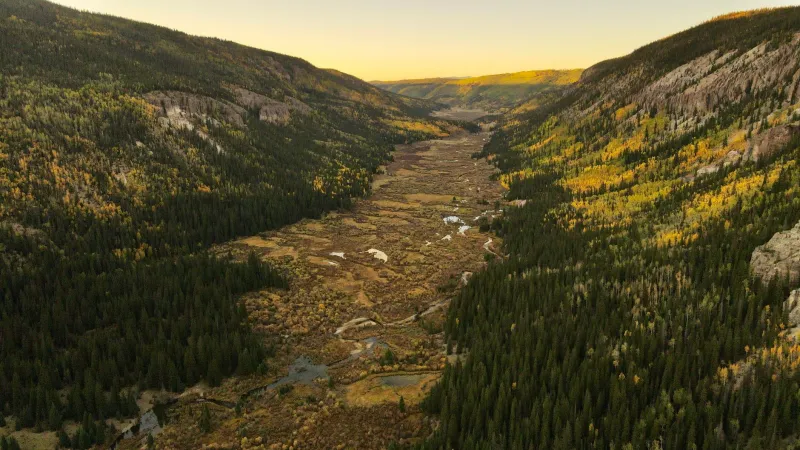
Wine drinkers have long obsessed over terroir — the idea that a place leaves its fingerprint on what you drink. The slope of a hillside, the mineral content of soil, the particular way afternoon light falls across a vineyard. For decades, brewers mostly shrugged at that conversation. Beer, after all, is brewed indoors. You control the variables. You dial in the recipe.
Except you don't. Not entirely. Not here.
The Roaring Fork Valley has a way of making itself known in the glass, whether you're looking for it or not. And the more we've learned about this specific stretch of western Colorado — from the ancient geology beneath our feet to the snowpack draining off the Elk Mountains above us — the more convinced we are that brewing here produces something you simply cannot replicate anywhere else.
Start Underground: What the Rocks Are Actually Doing
Dr. Marcy Halvorsen, a geologist based in Glenwood Springs who has studied the Roaring Fork watershed for over fifteen years, puts it plainly: "People think of this valley as scenery. But what's underneath it is just as remarkable as what's above."
The valley sits atop a complex mix of Paleozoic marine sediments, Mesozoic sandstones, and younger volcanic intrusions from the West Elk Mountains. As water percolates through these layers — sometimes over decades before it ever reaches the river — it picks up a distinct mineral signature. Calcium, magnesium, bicarbonate, sulfate. Each one present in specific proportions that shift subtly depending on where exactly in the watershed the water originates.
For brewers, those minerals aren't background noise. They're ingredients.
"Water chemistry is the most underappreciated variable in craft brewing," says our head brewer, Travis Kowalski. "Most people think about hops and malt. But the mineral content of your water affects mash pH, enzyme activity, yeast health, and ultimately the flavor compounds that end up in your finished beer. We're working with source water that has a profile unlike anything you'd find in Denver or Fort Collins or the Front Range."
Specifically, the relatively elevated sulfate levels in our local water tend to accentuate hop bitterness and give our IPAs a crispness that's hard to engineer artificially. The calcium carbonate presence, meanwhile, softens roasted malts in our darker beers, rounding out edges that might otherwise taste harsh. We adjust and treat our water for different styles, sure — but we're always starting from a baseline that already has character.
The Snowpack Factor: Why Our Water Isn't Like Yours
The Roaring Fork River draws from some of the highest terrain in the continental United States. Independence Pass, sitting at 12,095 feet, feeds snowmelt into the upper valley. That water spends months locked in snowpack before slowly releasing through spring and early summer, filtering through alpine soils and granite before descending.
Granite-filtered water tends to be softer and lower in dissolved solids than water that has traveled through limestone-heavy terrain. It's part of why Bohemian-style lagers brewed in Pilsen, Czech Republic — another granite-bedrock region — developed their famously delicate, rounded character. We're not claiming to be Pilsen. But the geological parallel is real, and it shows up in our lighter lagers in ways that consistently surprise people tasting them for the first time.
"There's a cleanness to it," Travis explains. "When the water doesn't carry a heavy mineral load, your base malts get to speak more clearly. You're not fighting the water. It's almost transparent in the best possible way."
Altitude as Ingredient: Yeast at 8,000 Feet
We've written before about the fermentation science of high-altitude brewing, but it bears revisiting in the context of terroir because altitude isn't just a logistical challenge — it's a flavor variable.
At roughly 8,000 feet of elevation, atmospheric pressure is meaningfully lower than at sea level. Carbon dioxide escapes more readily during fermentation. Yeast behaves differently, producing slightly altered ester and fusel alcohol profiles depending on the strain and the fermentation temperature. Our brewers have spent years learning how our specific yeast strains perform at altitude, dialing in pitching rates and temperature curves that account for the elevation rather than fighting it.
The result is fermentation character that's genuinely distinct. Certain fruity esters that might be faint at sea level come through more expressively here. Some of the heavier fusel notes that can plague high-altitude brewing get managed out through careful temperature control. What remains is a fermentation signature that, once you know it, you start to recognize across our lineup.
Dr. Halvorsen calls it "a biological response to a specific place." We just call it ours.
Climate Patterns and the Seasonal Rhythm of Brewing
The Roaring Fork Valley sits in a climatic transition zone. To the west, you get the high desert influence of the Colorado Plateau — dry, warm, wide-open. To the east, the Elk and Sawatch Ranges create classic alpine conditions. The valley threads between them, producing weather patterns that shift dramatically by season and by elevation.
For brewing, those swings matter. Ambient temperatures in our cellar and taproom space fluctuate with the seasons in ways that influence how we schedule our brewing calendar. Our coldest lagering conditions happen naturally in winter, which is why we time several of our lager releases to take advantage of months of near-ideal cold conditioning. Summer's warmth suits our Belgian-influenced ales, which thrive in slightly elevated fermentation temperatures that coax out the complex phenolic and fruity notes those styles are known for.
We're not a fully climate-controlled industrial facility. We've made peace with that, and then some. The valley's seasons have become part of how we think about our production schedule, not as a limitation but as a guide.
Local Ingredients Close the Loop
Terroir, at its most complete, isn't just about water and weather. It's about what grows here. Our relationships with Colorado farmers — including grain growers on the Western Slope and hop yards in the mountain foothills — mean that a meaningful portion of our ingredient sourcing reflects the same regional character that defines our water and our climate.
Colorado-grown barley carries flavor nuances from the high-altitude soils and intense summer sun of its growing region. Western Slope hops, still a small but growing category, bring aromatic profiles shaped by the same geography we call home. When those ingredients meet our local water and ferment in our high-altitude cellar, the result is a beer that couldn't have been made the same way anywhere else.
That's not marketing language. That's just geography doing what it's always done — leaving its mark on the things people make in a place.
Why It Matters
Craft beer in America has exploded in the last two decades, and the industry is better for it. But as the market matures, the beers that endure will be the ones that taste like somewhere specific. Not a recipe. A place.
The Roaring Fork Valley has given us something rare: a brewing environment with genuine, measurable, scientifically interesting distinctions that show up in the finished product. The geology, the snowmelt, the altitude, the climate swings, the local ingredients — they all converge in the glass.
Next time you're sitting at the taproom with a pint in hand, take a second before that first sip. What you're about to drink was shaped by forces that have been at work here for millions of years. We just showed up, paid attention, and tried not to get in the way.