Good Things Take Time: The Slow Brews Behind Some of Our Most Celebrated Beers
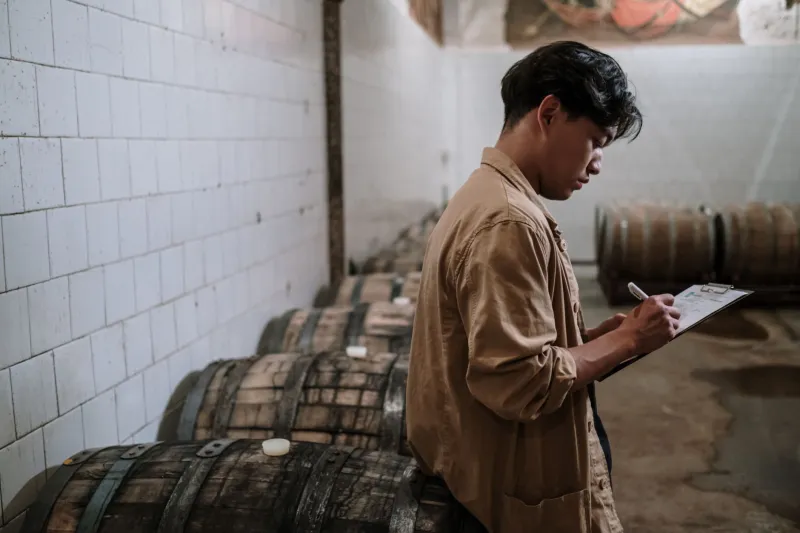
There's a corner of our brewery that doesn't get a lot of foot traffic. It's not loud. It's not flashy. It smells incredible, though — a deep, woody, almost caramel-sweet funk that settles into your clothes if you stand there long enough. That's the barrel room, and it's where some of our most important work happens at a pace that would make most modern brewers deeply uncomfortable.
We live in a world that rewards speed. Same-day delivery, instant streaming, two-week turnarounds. Craft beer, for all its artisanal reputation, isn't entirely immune to that pressure. Taproom taps need to stay fresh. Seasonal releases have windows. Keeping the lights on means keeping product moving.
But there's another side to this brewery — quieter, slower, and in many ways more interesting. It's the side that asks: what happens if we just wait?
Why Rush What the Yeast Already Knows
Our head brewer, Marcus, has a saying he repeats often enough that it's practically tattooed on the fermentation room wall: "The yeast doesn't care about your timeline."
He means it literally. Extended fermentation — letting a beer condition for weeks or months beyond a standard schedule — isn't something you can force. The chemistry has its own clock. Certain esters need time to develop. Harsh alcohol notes need time to mellow. Complex malt characters that taste rough and unfinished at week three can transform into something genuinely stunning by week fourteen.
Mass-market breweries don't have that luxury. When you're producing millions of barrels a year, every day a tank sits occupied is a day it's not generating revenue. The economics of patience simply don't pencil out at scale.
For us, working at a fraction of that volume in the heart of the Roaring Fork Valley, the math is different. We can afford — sometimes barely, but still — to let certain beers breathe.
The Barrel Program: Where Time Becomes Flavor
Our barrel-aging program started almost by accident. A local distillery outside Glenwood Springs was rotating out some spent bourbon casks, and Marcus asked if we could take a few off their hands. We filled them with a robust winter stout, shoved them in the back corner, and then — honestly — got busy with other things.
Six months later, we cracked one open expecting something rough and unfinished. What we got instead was a beer that had absorbed the oak's vanilla and char, picked up ghost notes of bourbon without losing its core identity, and developed a smoothness that no amount of recipe tweaking could have manufactured.
That was the beginning.
Now we run a rotating inventory of barrels — bourbon, rye whiskey, wine, and occasionally something more unusual — each holding a different base beer at a different stage of its transformation. Some will be ready in six months. Some won't be touched for two years. A few we honestly don't know yet. We check them periodically, take small samples, make notes, and then close them back up.
It requires a kind of discipline that goes against every instinct to tinker. The best thing you can do for a barrel-aged beer, more often than not, is absolutely nothing.
Specific Brews Worth Knowing About
Confluence Barrel Stout — This one started as a big imperial stout brewed in late October. It spent fourteen months in a single-barrel bourbon cask before we deemed it ready. The result was a beer with layers that unfold slowly in the glass: dark chocolate up front, a mid-palate wave of dried fruit and caramel, and a finish that lingers with just enough warmth to remind you what was in that barrel before our beer was. We released it as a limited run of 48 bottles last winter. It sold out in a weekend.
High Country Wild Ale — This one's still going. We inoculated a saison base with wild yeast cultures and transferred it to neutral oak over a year ago. Wild fermentation is even less predictable than extended conventional fermentation — the microflora do what they want, and your job is mostly to stay out of the way and monitor pH. When it's ready, it'll be tart, funky, and deeply complex. We're guessing another eight months, but we've been wrong before.
Slow River Lager — Not every slow brew lives in a barrel. Our lager program uses traditional cold-conditioning techniques that take nearly three times as long as most modern lager production. The result is a beer with exceptional clarity, a clean crispness that tastes almost effortless, and zero of the rough edges that shortcuts tend to leave behind. It's one of our most approachable beers, and ironically one of the most labor-intensive.
The Philosophy Behind the Practice
Marcus is quick to point out that patience in brewing isn't romanticism — it's craft. "There's nothing magical about waiting," he says. "What you're really doing is giving the beer the conditions and the time it needs to become what it's supposed to be. That's not patience for its own sake. That's just doing the work correctly."
That framing matters. A lot of the language around slow brewing can tip into preciousness — as if the waiting itself is what makes a beer valuable. It isn't. What makes it valuable is the outcome: flavors and textures that genuinely couldn't exist any other way.
The Roaring Fork Valley has a way of reinforcing that perspective. Out here, you watch seasons change with a clarity you don't get in a city. You see what the mountains look like after a decade of snowpack variations. You understand, on some level that's hard to articulate, that the best things in this landscape took an incomprehensible amount of time to become what they are.
It's not a bad mindset to bring into a brewery.
When You Can Try Them
Slow and limited-release beers show up at the taproom a few times a year, usually with minimal advance notice. The best way to stay in the loop is our email list and our social channels, where we announce releases as they happen. Some of these beers make it into bottles. Some are draft-only, available until the keg runs out.
If you're the kind of person who prefers to plan ahead, we get it — but part of what makes these beers special is exactly that they can't be scheduled. They're ready when they're ready.
And trust us: when they're ready, they're worth it.