Liquid Geology: How the Roaring Fork Watershed Becomes the Secret Ingredient in Every Pint We Pour
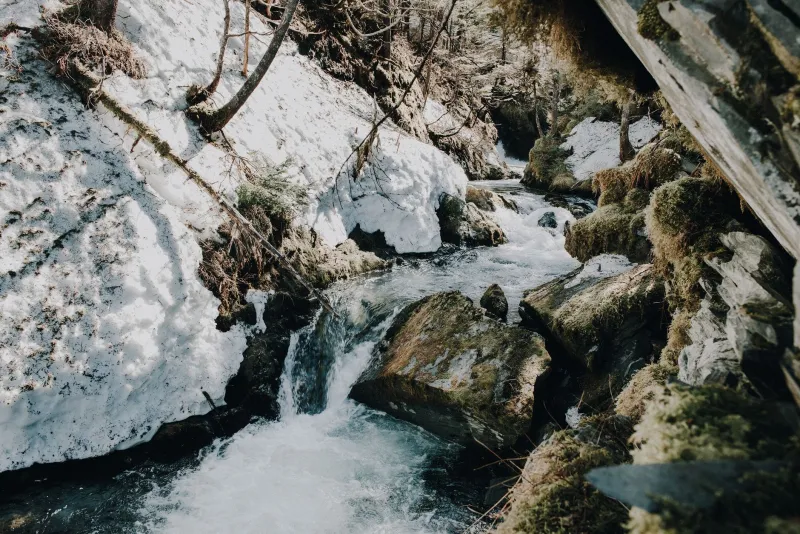
There's a phrase that gets thrown around a lot in craft brewing circles: terroir. Wine folks borrowed it from the French, and now beer people use it to describe that ineffable sense of place you get in a well-made pint. We've always been a little skeptical of the word — it can sound pretentious — but after spending a few hours talking water chemistry with Dr. Renata Osgood, a hydrogeologist who's studied the Roaring Fork watershed for the better part of two decades, we're starting to think terroir might actually be underselling what's going on in our brewing water.
Because what comes out of this watershed isn't just cold and clean. It's specific. And that specificity, it turns out, is one of the most meaningful competitive advantages we have.
What's Actually in the Water
When snowpack from the Elk Mountains melts and filters down through layers of granite, limestone, and Precambrian metamorphic rock, it picks up a very particular suite of dissolved minerals. The Roaring Fork watershed sits at the intersection of multiple geological formations, which means the water arriving at our source point has passed through an unusually diverse mineral environment.
The result is water with moderate hardness — typically in the 80 to 120 parts-per-million range for calcium — alongside notably low sodium, controlled sulfate levels, and a bicarbonate concentration that gives us real flexibility in pH adjustment. That last part matters more than most people realize.
"The bicarbonate buffering capacity of this water is genuinely unusual," Dr. Osgood told us. "It's soft enough that brewers can build up from a clean baseline, but it's not so stripped down that you're working with a blank slate that requires heavy mineral additions. It sits in a sweet spot that a lot of brewers would kill for."
Our head brewmaster, Caleb Trout, has been dialing in our water profiles for going on eight years now. He put it more bluntly: "I've brewed at facilities in the Front Range and down in the Southwest. The water you start with determines how much work you're doing before the first grain even hits the mash tun. Here, I spend a fraction of the time on water chemistry that I used to. The watershed does the heavy lifting."
pH, Yeast, and the Invisible Architecture of Flavor
If you've never thought much about pH in brewing, here's the short version: mash pH — typically targeting somewhere between 5.2 and 5.4 — controls how efficiently enzymes break down starches into fermentable sugars. Get it wrong and you're either leaving body and mouthfeel on the table or ending up with a thin, harsh finish. Get it right and the whole beer comes together with a kind of structural integrity that's hard to articulate but immediately apparent in the glass.
Our source water's natural pH, combined with its mineral profile, means we hit that target range with minimal intervention on most of our core styles. That's not a small thing. Every adjustment you make to water chemistry — every gram of gypsum or calcium chloride you add — introduces a variable. Fewer variables means more consistency, and more consistency means the beer you loved three months ago tastes exactly the way you remember it today.
Yeast behavior is the other piece of this puzzle that doesn't get enough attention. Yeast strains are sensitive to mineral content in ways that directly influence ester production, attenuation rates, and flocculation. The moderate calcium levels in our water support healthy yeast activity without pushing fermentation in directions we don't want. Caleb describes it as the difference between a yeast strain performing and thriving.
"When yeast is happy, the beer tells you," he said. "You get cleaner fermentation, more predictable flavor development. The water here creates conditions where our house strains consistently do what we need them to do."
Hops and the Sulfate Question
Here's where things get interesting for hop-forward styles. Sulfate levels in brewing water have a well-documented relationship with hop perception — higher sulfate tends to accentuate bitterness and give it a drier, crisper edge, while lower sulfate softens the finish and lets hop flavor linger without sharpening into harshness.
Our watershed water comes in at naturally moderate sulfate levels, which gives us a useful starting point for a wide range of styles. For our IPAs and pale ales, we can build sulfate up selectively to sharpen the hop profile. For maltier styles — our amber, our seasonal lagers — we keep it closer to baseline and get a rounder, more integrated bitterness.
What we don't have to do is fight the water. Breweries working with high-sulfate sources often have to work around that characteristic when brewing softer styles. We start from the middle and move in either direction as the recipe demands. It's a flexibility that Dr. Osgood says is a direct function of the geological diversity in our watershed.
"You're getting water that's traveled through multiple rock types," she explained. "That diversity in the source geology produces a more balanced mineral profile than you'd get from a watershed dominated by a single formation. It's actually pretty rare."
Why You Can't Just Ship This Water
We get asked occasionally whether we've considered contract brewing — having another facility produce some of our beers under our label to meet demand. The water question is a significant part of why we've never seriously pursued it.
You can adjust mineral content. You can add calcium, magnesium, chloride, sulfate. What you can't easily replicate is the natural buffering capacity, the trace mineral interactions, and the organic baseline that comes from water that's spent years filtering through a specific piece of mountain geology. It's not magic — it's chemistry — but it's chemistry that took millennia to develop and that exists, as far as we know, in one place.
Caleb keeps a running log of every water chemistry test we've done going back to the brewery's earliest days. He pulled it up during our conversation and pointed to how remarkably consistent the numbers have been across seasons, across years, across weather patterns. "It varies," he said, "but it varies within a range that tells me this watershed is stable and predictable in a way that's genuinely valuable. That's not something you take for granted."
Tasting the Difference
All of this is interesting to talk about in the abstract. But the real test is in the glass.
Next time you're at the taproom, order a flight and pay attention to the finish on each pour. Notice how the bitterness resolves — not abruptly, but with a kind of ease. Notice the way the malt character sits clean without being thin. That's not just recipe design or yeast selection or hop sourcing, though all of those matter. That's the watershed working quietly in the background, the way good ingredients always do.
The Roaring Fork River has been shaping this valley for longer than anyone's been keeping records. We're just the latest operation to figure out that the best thing you can do is pay attention to what it's already doing — and then get out of the way.