From Handle to Glass: The Hidden Craft Behind Every Perfect Pint
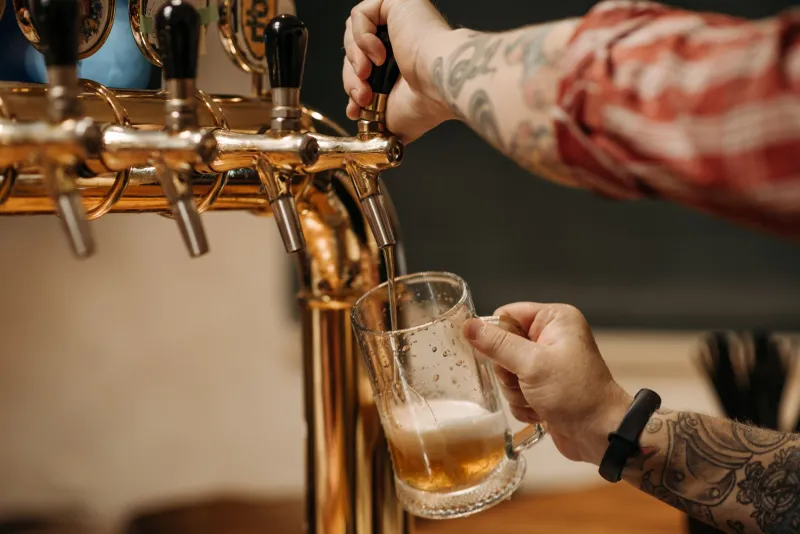
There's a moment that happens dozens of times a day behind our bar. A guest settles onto a stool, scans the tap list, and points to something that sounds good. What happens in the next fifteen seconds—before that glass ever hits the coaster—shapes everything they're about to taste. And most people never give it a second thought.
That's the quiet craft of the pour. It doesn't get the Instagram posts that a hazy New England IPA gets, and it doesn't show up in the tasting notes on our chalkboard menu. But ask anyone who's worked our taproom long enough, and they'll tell you: the same beer can taste wildly different depending on how it lands in the glass.
It Starts Before the Tap Even Opens
Before our servers pull a single handle, they're thinking about temperature—both the beer's and the glass's. Our lines run cold, typically between 36 and 38 degrees Fahrenheit, but a room-temperature glass can spike the perceived temperature of that first pour by several degrees in seconds. That matters more than you'd think.
"A warm glass is one of the fastest ways to blow the aromatics on a delicate beer," says Marcus, one of our lead bartenders who's been slinging pints at Roaring Fork for going on four years. "You get this flash of heat right at the rim, and suddenly a dry-hopped pale ale smells like wet cardboard instead of citrus. The guest thinks the beer is off. Nine times out of ten, it's the glass."
We rinse every pint glass with cold water before the pour—a small habit that takes about three seconds and makes a measurable difference. It's the kind of detail that separates a taproom that takes its beer seriously from one that's just moving product.
The Angle Is Everything
Ask a new server to pour a beer and they'll almost always start with the glass held straight up. It's intuitive. It's also wrong.
The correct technique begins with the glass tilted at roughly 45 degrees, held just below the tap faucet without touching it. (Contact between the faucet and the glass is a contamination risk and a pet peeve of every experienced bartender we've ever hired.) The beer flows down the inside wall of the glass, minimizing agitation and reducing the amount of CO2 that escapes prematurely.
As the glass fills to about halfway, you gradually bring it upright. That transition is where the head forms—and the head, despite what some drinkers believe, is not something to avoid.
In Defense of the Head
American beer culture has a complicated relationship with foam. A lot of drinkers see a foamy head as lost beer, a sign that someone behind the bar is either lazy or trying to shortchange them. We get it. But that instinct is working against you.
Foam is where aroma lives. The act of forming a proper head—typically one to one-and-a-half inches on most of our ales and lagers—releases volatile aromatic compounds that would otherwise stay trapped in the liquid. When you bring a glass to your lips and inhale before you drink, you're smelling those compounds. That smell is roughly 70 to 75 percent of what your brain registers as flavor.
Skip the head, and you're essentially tasting with one hand tied behind your back.
"I always tell guests who ask for 'no foam' that I understand where they're coming from, but I'll ask them to try it with a proper head first," says Dani, another member of our taproom crew who came to us from a craft beer bar in Denver. "Usually they come around. The beer just tastes more like itself."
Different styles do call for different head profiles, though. A classic Czech-style pilsner—like the one we rotate through in the summer—traditionally carries a thick, dense white head that softens the bitterness and adds a creamy texture on the palate. Our darker stouts and porters get a tan or brown head that signals roasted malt character before you even take a sip. A well-poured hefeweizen gets a dramatic, billowing crown that's almost as much about the show as the science.
Glassware Isn't Just Aesthetic
We put real thought into which glass goes with which beer, and it's not just about looking good on the bar top. Glass shape directly influences how aromas concentrate and how carbonation behaves.
A tulip glass, with its flared lip and curved bowl, traps and focuses aromatics in a way that a standard shaker pint simply can't. We use tulips for our hop-forward beers—our West Coast IPAs, our double dry-hopped seasonals—because the geometry does work that the pour alone can't accomplish. The shaker pint is a workhorse, great for session lagers and easy-drinking ales where you want volume and accessibility over complexity. Our Belgian-inspired farmhouse ales go into a stemmed goblet that keeps your hand from warming the beer too quickly.
None of this is arbitrary. Every choice is in service of getting the beer to you in the condition we intended when we brewed it.
Training the Pour
When we bring on new taproom staff, pouring technique is part of the formal training—not an afterthought. New hires spend time with experienced bartenders before they ever work a solo shift, practicing on water to get the angle and transition right before they touch actual beer. We talk through why each step matters, not just what to do.
The goal isn't to produce robots who pour identically. It's to build servers who understand the principles well enough to adapt. A busy Friday night with a line three deep calls for efficiency without sacrificing quality. A slow Tuesday afternoon is a chance to slow down, talk through the beer with a curious guest, and maybe show them why that half-inch of foam on their amber ale is doing them a favor.
The Last Step in a Long Process
When our head brewer signs off on a batch, that beer has already been through weeks of fermentation, conditioning, and quality checks. The grain was sourced, the hops were selected, the water chemistry was dialed in for our elevation here in the Roaring Fork Valley. Every variable that could be controlled, was.
The pour is where all of that work either gets honored or squandered. We choose to honor it.
Next time you're at the taproom, watch what happens when your server pulls your pint. Notice the angle, the transition, the head. If you're curious, ask about it—our staff loves talking through the why. That conversation is part of the experience, and the experience is kind of the whole point.
See you at the bar.