Field to Fermenter: Meet the Colorado Farmers Who Help Us Brew Our Best Seasonal Beers
Every fall, without fail, the same thing happens at Roaring Fork Beer Co. Someone—usually a regular who's been coming in since we opened—sidles up to the bar and asks, "Is the harvest ale back yet?" And every fall, we get to say yes, because somewhere about 40 miles east of our taproom, a family farm just finished pulling in their barley crop, and those grains are already on their way to our brewhouse.
That's not an accident. It's a relationship years in the making, and it's the kind of thing that shapes everything about how we build our seasonal tap calendar.
Why Local Sourcing Isn't Just a Marketing Line
Let's be honest: a lot of breweries slap the word "local" on their labels without it meaning much. We've never been interested in that approach. For us, sourcing from regional farmers and producers is a practical commitment that directly influences what we can brew, when we can brew it, and how those beers taste.
Colorado's agricultural landscape is genuinely remarkable. The Western Slope produces some of the country's most interesting specialty crops. The San Luis Valley is one of the top barley-growing regions in the entire nation. And a growing community of hop farmers across the state is quietly changing what's possible for craft brewers who want to stay close to home.
When you build your seasonal calendar around what's actually growing nearby, you end up with a release schedule that reflects the real rhythm of the year—not a marketing department's idea of what autumn should taste like.
The Grain That Started It All: Valley Malt & Barley
Our relationship with Sunrise Grain Co. out of the San Luis Valley goes back to our second year of operation. Owner and third-generation farmer Dale Hutchins grows a heritage barley variety that most large maltsters won't touch because the yield per acre is lower than modern commercial strains. What it lacks in volume, it more than makes up for in flavor.
"Dale's barley has this nutty, almost biscuity character that you just don't get from commodity malt," says our head brewer Marcus Delray. "When we do our Harvest Amber in October, probably 40 percent of the grain bill is his floor-malted two-row. It's the backbone of the whole beer."
Dale himself is characteristically understated about the partnership. "I grow what I grow, and I'm glad somebody appreciates it," he told us on a recent visit to his operation. But watching him walk the rows of his barley field in late July, describing the soil conditions and moisture levels with the precision of someone who has spent decades learning to read the land, it's clear that his care translates directly into what ends up in your glass.
Our October Harvest Amber (dropping in taproom mid-October) is built almost entirely around Dale's crop. Expect a warm, toasty malt character with just enough Centennial hops to keep things balanced. It's a beer that tastes like Colorado in autumn, because it essentially is.
Hops from Down the Valley
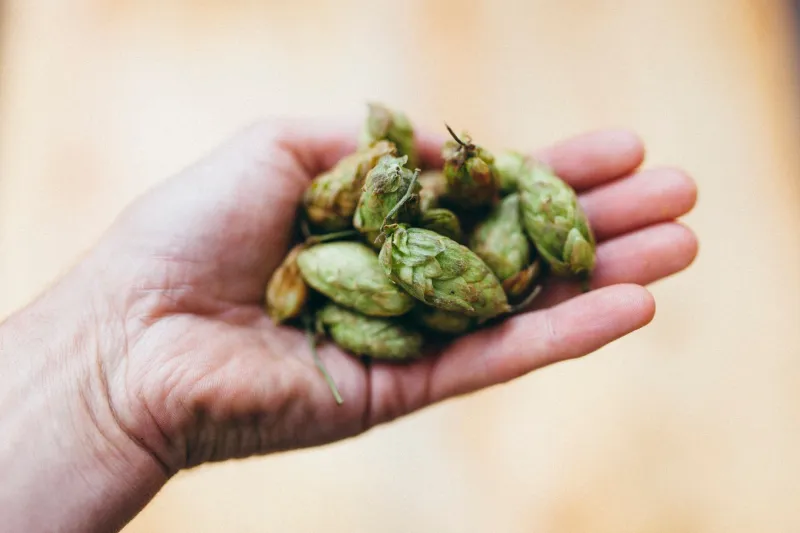
For years, sourcing local hops in Colorado meant either paying a premium for tiny specialty farms or just giving up and ordering from the Yakima Valley like everyone else. We did plenty of both. But over the last three years, a handful of hop growers along the Western Slope have scaled up enough to become reliable partners—and one of them, Ridgeline Hop Farm near Paonia, has become one of our most valued suppliers.
Sisters Camille and Britt Okafor started Ridgeline six years ago on land their family had been farming for decades. They grow four varieties, but the one that caught our attention immediately was their estate Cascade—a Colorado-grown version of one of America's most familiar hop varieties that somehow tastes wilder and more floral than anything coming out of the Pacific Northwest.
"There's something about the high desert soil and the temperature swings out there," Marcus says. "The same variety just expresses differently. Their Cascade has this bright, almost citrus-blossom thing going on that we can't replicate with anything we'd source from Washington."
This summer, we're releasing a Ridgeline Single-Hop Pale Ale as a limited run—a beer designed specifically to showcase the Okafor sisters' estate Cascade with minimal interference. It's a clean, dry pale ale with a soft malt base and a hop profile that's all Western Slope sunshine. We're planning a release party at the taproom in August, and the Okafor sisters will be there to pour alongside us.
Specialty Ingredients: The Wild Cards That Make Things Interesting
Not every local partnership starts with a grain or a hop. Some of our most memorable seasonal releases have been built around specialty ingredients that showed up almost by accident.
Two winters ago, a beekeeper named Theo Vásquez walked into our taproom with a jar of buckwheat honey from his hives in the North Fork Valley and asked if we'd ever thought about making a honey ale. We had. We just hadn't found the right honey. Theo's buckwheat variety is dark, almost molasses-like, with a complexity that most honey simply doesn't have.
The result was our Dark Star Honey Ale, which sold out in 11 days and has become one of our most requested seasonal returns. This year's batch is already locked in—Theo's 2024 harvest was excellent, and we've got enough honey reserved to brew a slightly larger batch than last time. Look for it on tap in late November, right around the time you're craving something warming and just a little bit wild.
We've also been working with a small lavender farm outside of Hotchkiss on what Marcus is tentatively calling a "Colorado Provence" saison—a dry, effervescent summer beer with a whisper of lavender and local wildflower honey. It's still in development, but early test batches have been genuinely exciting.
How the Seasons Actually Drive the Calendar
Here's the thing about building a tap calendar around local agriculture: you have to be comfortable with uncertainty. Crops don't follow spreadsheets. A late frost can push a hop harvest back by two weeks. A dry summer can change the flavor profile of an ingredient in ways you didn't anticipate.
For us, that's not a problem to be managed—it's a feature. It means every seasonal release is genuinely tied to what happened on Colorado farms that year. A great barley harvest produces a richer, more complex amber. An unusual summer produces hops with unexpected character. The beer becomes a kind of snapshot of the season, and no two years are exactly alike.
"I think that's what people respond to," Marcus says. "They can taste that something real went into it. It's not engineered to be consistent. It's consistent because we care, but it's alive because the ingredients are alive."
If you want to stay up to date on what's coming out of our fermenters this season—and which local farm made it possible—follow along on our social channels and keep an eye on the seasonal board next time you're in the taproom. We'll always tell you where your beer came from. That's kind of the whole point.